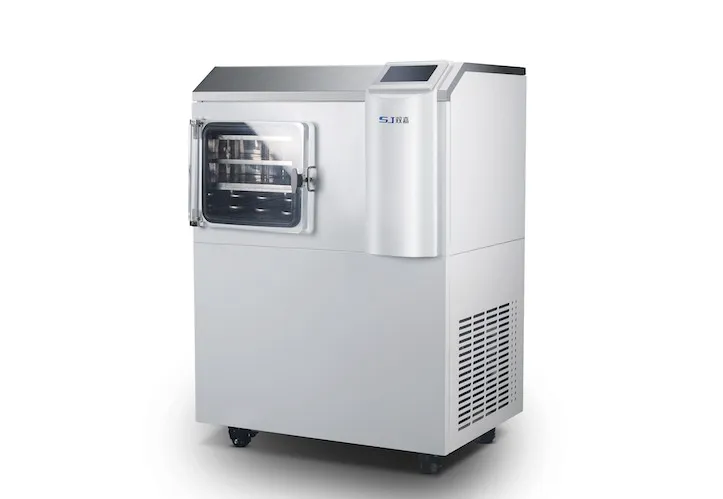
Peptide cycle development becomes easier to defend when each run is planned as a measurement exercise rather than a search for one universal recipe. This guide shows how a laboratory team can use a shelf-controlled LT-P24 / Creator 2S platform to relate commanded conditions to the temperatures and endpoint signals observed across a representative vial load. It does not prescribe formulation setpoints or claim a validated cycle.
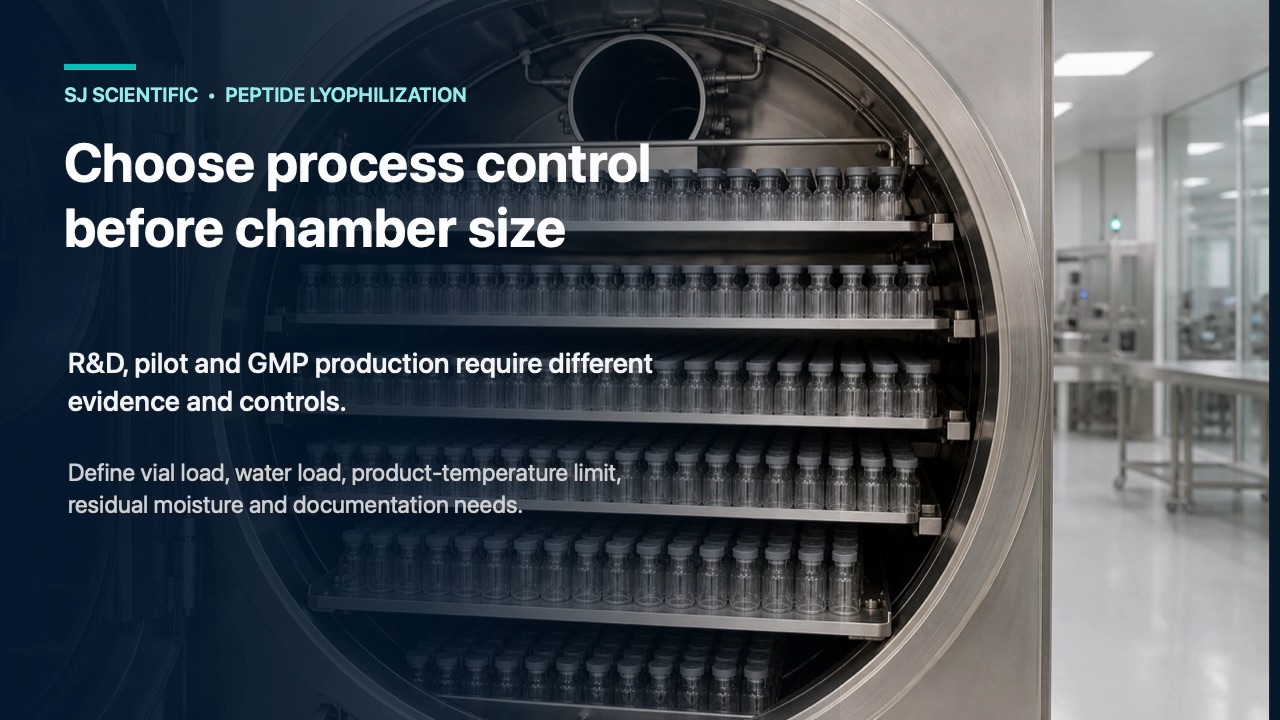
A short selection overview connecting controlled-shelf development, vial loading, condenser duty and the transition into GMP lyophilization.
Start with an evidence map, not a borrowed recipe
Define the decision that the run must support: freezing repeatability, primary-drying margin, endpoint interpretation or transfer readiness. Keep the vial, stopper, fill depth, formulation and loading pattern fixed while that question is studied.
Before the run, list the formulation-specific product-temperature limit and the analytical observations that will be reviewed afterward. Those values belong to the development protocol; LyofiTech does not publish a generic peptide temperature, pressure, moisture or cycle-time target.
- Record vial and stopper drawings plus fill depth.
- Mark loaded and empty shelf areas.
- State which process variable is intentionally changed.
- Predefine the evidence required to accept or reject the change.
Map commanded shelf conditions to actual shelf response
Record the programmed ramp, hold and pressure sequence together with the measured shelf-fluid or shelf-surface response available from the configured system. The useful comparison is not only the setpoint; it is how consistently the equipment reaches and holds the intended condition under the selected load.
For LT-P24 studies, note shelf position, partial-load geometry, condenser readiness and the timing of valve or vacuum events. These details help distinguish a recipe effect from an equipment transition or an uneven loading pattern.
Place product-temperature probes to answer location questions
Use representative edge and center positions and document probe depth, vial contact and shelf location. An instrumented vial can behave differently from an uninstrumented vial, so a probe is evidence about a location rather than proof for every container.
Review the warmest observed product location against the formulation-specific limit. Also compare the spread and timing between locations; a seemingly acceptable average can hide a local loss of margin.
Use several endpoint signals as a converging argument
Product temperature approaching shelf behavior, Pirani and capacitance-manometer convergence when both are configured, pressure-rise response and declining vapor demand can each support an endpoint decision. None of them alone proves that every vial has completed primary drying.
Record which signals were available, when they changed and what post-endpoint hold was used. The run conclusion should state the uncertainty as well as the proposed next action. Product testing, including any residual-moisture or quality assessment, is defined and performed by the user rather than inferred from the equipment trace.
Build a run matrix that changes one question at a time
After a conservative mapping run, adjust one primary variable or one freezing variable while maintaining the other defined inputs. Compare synchronized traces, location spread, endpoint behavior and the project-specific analytical observations.
Use repeat runs and realistic partial or fuller load patterns to learn whether the proposed operating window is robust. A shorter trace is not automatically a better protocol if it reduces product-temperature margin or makes endpoint evidence less consistent.
Package the evidence for transfer
The transfer file should include the LT-P24 / Creator 2S equipment configuration, calibrated measurement list, vial map, shelf program and actual trends, product-temperature locations, pressure data, condenser observations, endpoint rationale, deviations and analytical references.
The receiving lyophilizer must be compared for shelf geometry, heat transfer, pressure control, vapor path and condenser duty. Transfer the intended product history and evidence logic; do not treat the laboratory recipe file as a scale-independent instruction.
Frequently asked questions
Does shelf temperature represent peptide product temperature?
No. Product temperature also depends on vial heat transfer, fill depth, dry-layer resistance, pressure, radiation and load position. Measure representative product locations for the purpose of the study.
Is Pirani and capacitance-manometer convergence enough to call the endpoint?
It is useful supporting evidence when both measurements are available, but should be interpreted with product-temperature trends, pressure-rise or other qualified checks, load position and the study acceptance plan.
Can the LT-P24 recipe be copied directly into a GMP lyophilizer?
No. Compare shelf geometry, loading, heat transfer, pressure control, condenser duty and vapor conductance, then confirm the intended product history on the receiving equipment.
This page provides general engineering and operating context. The model-specific manual, approved site procedure, technical agreement and product validation take priority.