A vial can fit on a shelf and still be a poor development load. The half-stopper may restrict the vapor path, the tray can change edge heat transfer, a carrier may block probe placement, and the resulting water load can exceed the condenser margin used in a small-screening run. A useful transfer map therefore joins the physical handling steps to the temperature and endpoint evidence that the next scale must reproduce.
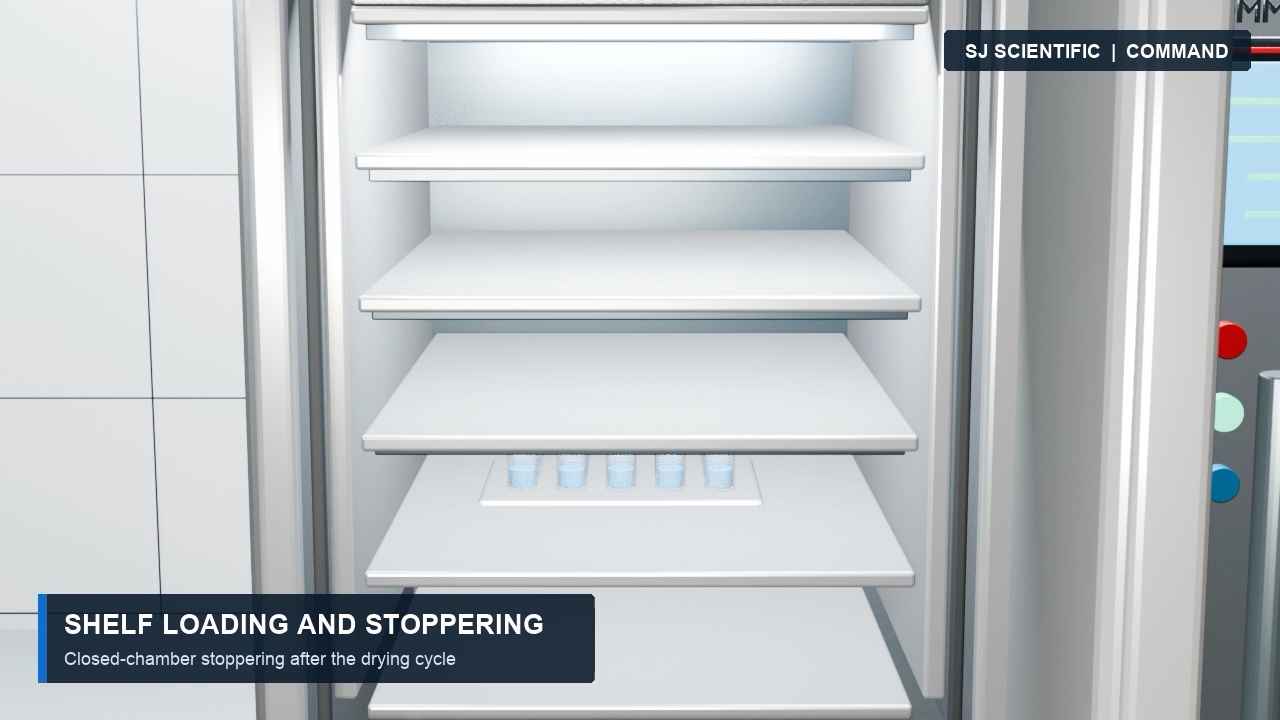
A silent 19-second visualization linking filling, half-stopper placement and tray loading to a controlled-shelf lyophilizer. It is not a laboratory result or validated recipe.
What the development map should record
| Visual source | 19-second silent 3D workflow; 1280 × 720; illustrative rather than experimental evidence |
|---|---|
| Container input | Approved vial and stopper drawings, half-stoppered height, fill depth and closure travel |
| Load input | Representative tray or carrier, vial restraint, edge clearance and probe locations |
| Thermal evidence | Shelf setpoint and mapped product temperature at defined load locations |
| Endpoint evidence | A project-approved combination of pressure, temperature and analytical observations |
| Vapor-load basis | Water per vial × planned batch, reviewed with sublimation rate, condenser and vapor path |
| Command selection reference | 1.08–3.51 m² nominal shelf area; 4–13 shelves; 450 × 600 mm each; configuration range only |
| Evidence status | Planning framework; no formulation, customer batch or validated result is claimed |
Start with the half-stoppered handling envelope
Record the vial outside diameter, body height, neck geometry, stopper drawing and the highest half-stoppered condition. That condition affects shelf clearance, vapor escape, transfer stability and the distance the stoppering mechanism must travel.
A rendered 10R proportion cannot substitute for the actual container-closure drawings. Fill depth and carrier details also have to be supplied before shelf spacing or load density is released.
Build the tray and probe plan together
Define how vials are restrained, where the tray edges sit, how a carrier bridges the transfer and which positions remain available for product-temperature probes. A dense geometric pattern can leave no credible measurement positions or safe handling allowance.
Map centre, edge and anticipated slow or fast locations according to the development objective. The record should distinguish shelf-fluid temperature, shelf-surface mapping and actual product temperature rather than treating one sensor as all three.
Convert the fill plan into a vapor-load question
Calculate water per vial from the formulation and fill volume, then scale by the planned quantity. Couple total ice load with the expected primary-drying rate, because condenser capacity and vapor-path conductance are challenged by both amount and rate.
Vial positions therefore describe geometry, not process capacity. Condenser temperature alone is also incomplete without ice capacity, refrigeration duty and the pressure-control requirement.
Define endpoint evidence before comparing cycles
A development run should state which observation supports the end of primary drying and which confirms secondary drying. Candidate evidence can include the intended pressure-sensor comparison, product-temperature response and project-approved analytical testing.
Do not infer an endpoint from the 19-second animation. It has no spoken process record and does not represent the duration of freezing, primary drying, secondary drying, backfill or stoppering.
Package the evidence for the next scale
The transfer packet should contain the container drawings, formulation and fill data, load diagram, probe locations, product-temperature trends, endpoint rationale, deviations and the equipment configuration used for each run.
At scale-up, compare shelf area, shelf spacing, heat-transfer behavior, vapor path, condenser duty and loading method. Preserve the critical product-temperature and endpoint logic while adapting setpoints to the larger equipment.
Vial-to-shelf development FAQ
Can a vial-position estimate define lyophilizer capacity?
No. It is a geometric starting point. Fill volume, total water, sublimation rate, vapor path, condenser duty, process margin and handling allowances determine the usable process load.
Why is the half-stoppered height more useful than vial height alone?
It represents the highest handling and drying condition and affects vapor clearance, shelf spacing, carrier stability and stoppering travel.
Does the animation provide product-temperature or endpoint data?
No. Those measurements must come from representative development runs with a documented load and instrument plan.
What should be preserved during scale-up?
Preserve the container-closure basis, load geometry, critical product-temperature limits, endpoint rationale and water-load calculation, then reassess heat and mass transfer on the target equipment.